
The Philadelphia Mint produced 562,052,000 specimens of the 25-cent coin in 1988.
Such a production volume classifies the issue as mass-produced, excluding the rarity factor for the majority of coins.
Evaluating the feasibility of keeping a specific 1988-P specimen requires verifying its compliance with strict numismatic criteria.
An average coin from circulation having mechanical damage possesses no potential for 1988 P quarter value growth.
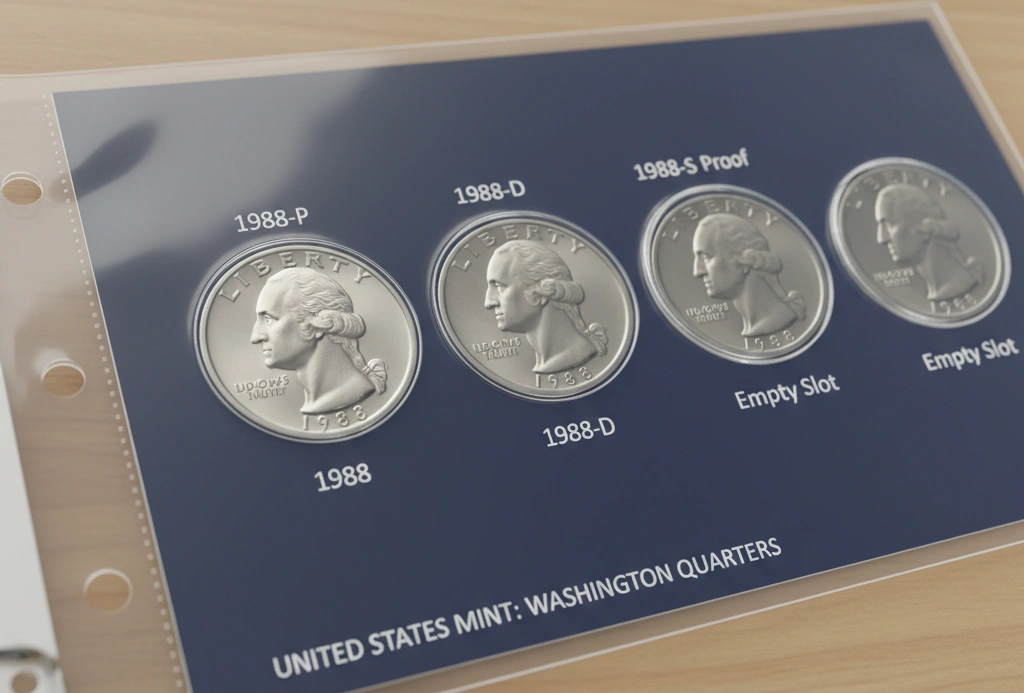
1988-P quarters are manufactured from a copper-nickel alloy applied to a copper core.
The coin's weight amounts to 5.67 grams with a diameter of 24.3 mm.
The surface condition remains the key parameter determining the object's market liquidity.
Preservation Degree | Visual Signs | Market Status |
Circulated (G-AU) | Presence of wear, absence of luster | Consumable material |
Uncirculated (MS60-64) | Presence of minor scratches, contact marks | Minimal premium |
Choice Uncirculated (MS65-66) | Strong luster, isolated marks | Collector object |
Superb Gem (MS67+) | Near-perfect condition | Investment object |
Retaining coins in conditions below MS65 is not economically justified due to inflationary losses exceeding nominal price growth.
Price Statistics and Auction Records
The value of 1988-P coins demonstrates a significant spread depending on the score on the Sheldon Scale.
For top-category specimens, the following price indicators are recorded:
MS66: The average price varies from 15 to 25 US dollars.
MS67: The value reaches 150–200 dollars, showing an annual growth at the 4-6% level.
Record: A 1988-P specimen in MS67 grade was sold at Heritage Auctions for 1,140 dollars.
Price dynamics for the MS67 grade over the last 5 years are characterized by volatility within 12% due to the appearance of new certified samples.
Rarity Factors of Top Grades
The rarity of 1988-P coins in MS67 condition is explained by the specifics of the packaging process at the mint.
Coins falling into steel bins immediately after striking receive multiple contact damages (bag marks).
Finding a specimen without a single scratch among a half-billion mintage represents a statistical anomaly.
According to the PCGS Population Report, the number of 1988-P coins in MS67 grade amounts to fewer than 100 pieces.
Analysis Year | Quantity in MS67 (PCGS) | Population Change |
2018 | 72 | - |
2021 | 85 | +18% |
2024 | 94 | +10.5% |
Increasing the population of certified coins leads to a gradual decrease in the auction value of rare grades.
Identification of Confirmed Mint Errors
Retaining a 1988-P coin is justified upon the presence of pronounced manufacturing defects.
Off-Center Strike
The defect occurs during the incorrect feeding of the planchet into the die pair.
Coins with a 10% offset are worth approximately 20–30 dollars.
An offset exceeding 50% with the 1988 date retained is valued at 150–300 dollars.
Double Struck
This arises during a repeated die strike on an already minted coin.
The value of such objects starts from 200 dollars and grows proportionally to the degree of deformation.
Die Cracks
Thin raised lines on the coin field indicate the destruction of the working tool.
Minor cracks add no significant value, requiring the presence of substantial "metal flows" (Cud errors).
Verification Procedure and Certification Costs
Before deciding to keep a coin, it is necessary to calculate the cost of its professional evaluation.
Certification with companies, such as a free coin identifier or NGC, includes the following expenses:
Membership fee for the numismatic society.
Evaluation cost for a single specimen (approximately 25–40 dollars).
Safe shipping expenses.
If the estimated market price of the coin is less than 100 dollars, the grading procedure becomes unprofitable.
Independently storing an uncertified coin in hopes of its future value does not guarantee liquidity during subsequent sale.
Rules for Physical Preservation of the Object
Upon deciding to leave a 1988-P coin in a collection, it is necessary to prevent the degradation of its surface.
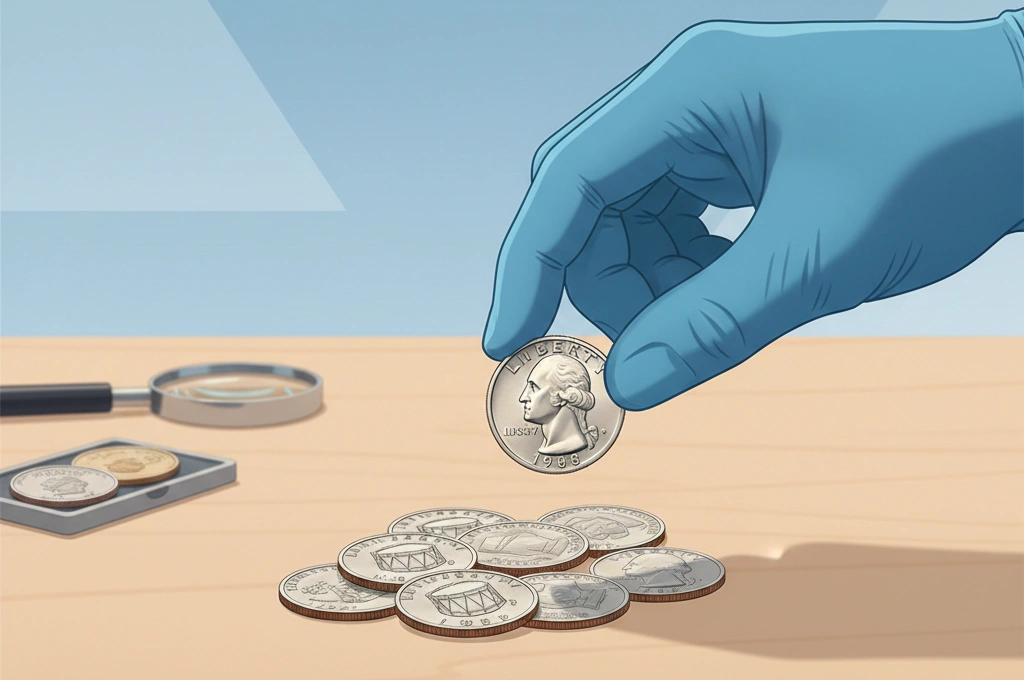
Excluding skin contact: Fatty secretions from fingers initiate corrosion of the copper-nickel layer.
Temperature control: Sharp temperature fluctuations cause micro-cracks in the clad layer.
Chemical neutrality: Storage in materials containing PVC leads to the appearance of "green slime," destroying the mint luster.
The use of acrylic capsules or sulfur-free paper holders is a mandatory condition for long-term retention.
Comparison of 1988-P with Other Release Years
Analysis of late 80s quarters shows similar market patterns.
The 1987 and 1989 issues have comparable mintages and similar preservation problems in top grades.
However, 1988 Philadelphia coins show a slightly higher frequency of die defects compared to Denver issues.
This makes searching for errors on the 1988-P a more productive activity for specialized numismatists.
Economic Forecast for the Next Decade
The value forecast for 1988-P coins is based on demographic changes in the collector community.
Demand for standard Washington quarters is maintained by participants in Registry Sets programs.
With a stable number of collectors, the price for MS67 will fluctuate depending on dollar inflation, averaging 3-5% growth annually.
Investments in MS65 and lower grade coins are recognized as ineffective due to high competition and excess supply.
Final Action Protocol
To determine the necessity of keeping a coin, one should follow the algorithm:
Step 1: Identification of the "P" mark under the "In God We Trust" inscription.
Step 2: Verification of mint luster (lustre). In its absence, the coin is returned to circulation.
Step 3: Search for mechanical damage using a coin appraisal app.
Step 4: Cross-referencing identified defects with registries of known errors.
Only specimens passing all verification stages without identifying flaws are subject to encapsulation.
Objective analysis confirms that for 99% of coins found in daily life, the answer regarding value is their face value.
Only exceptional samples having retained their pristine appearance deserve a place in numismatic archives.