
Chinese monetary traditions relied on cast bronze disks featuring a square central void for over two thousand years.
Specimens made from precious metals demonstrate the highest rates of coin with square hole value appreciation.
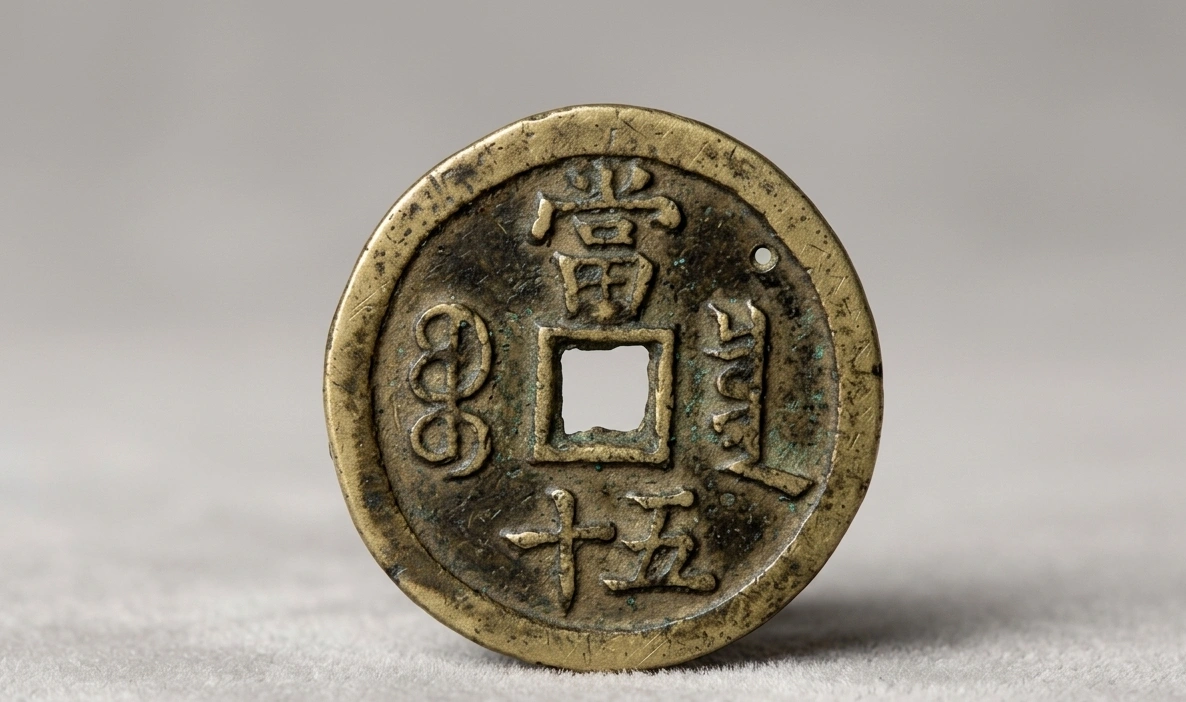
Era / Dynasty | Coin Type | Standard Mass | Primary Metal |
Qin | Ban Liang | 7.8 grams | Bronze with high copper content |
Han | Wu Zhu | 3.2 grams | Refined Bronze |
Tang | Kai Yuan | 3.7 grams | Alloy of Bronze, Tin, and Lead |
Qing | Qian Long | 4.5 grams | Brass |
Maintaining weight consistency served as a primary guarantee of authenticity in ancient times.
Deviating from these standards in 2026 is viewed by experts as a sign of unofficial or illegal casting.
Systemic Classification as a Foundation for Collecting
Categorizing these coins involves analyzing several independent physical markers.
Numismatists employ a hierarchical structure to identify rare sub-varieties among thousands of similar pieces.
Classification Funnel →
Dynasty (The overarching historical period)
Reign Title (The specific text found on the coin's front)
Mint Mark (Symbols on the back indicating the production site)
Calligraphy Type (Variations in how characters were written)
Casting Flaw (Manufacturing errors that create unique rarity)
Having such a system transforms a chaotic pile of objects into a structured scientific archive.
This organization allows for the precise determination of rarity for every individual specimen.
2026 Auction Records and Market Dynamics
Investment potential for rare cast coins continues to show annual growth in current trading cycles.
Recent sales data from the latest calendar period reveals significant returns:
Lot Description | Condition | Realized Price | Growth since 2025 |
10 Zhu (Xin Dynasty) | VF | $12,500 | +9.5% |
Xuan He (Gold, Song) | EF | $42,000 | +14% |
Tian Qi (10 Wen, Ming) | Fine | $3,800 | +5.2% |
Kai Yuan (Silver, Tang) | Choice VF | $8,600 | +11% |
Statistics confirm that rare metal alloys significantly outperform mass-produced currency.
Common coins in poor condition experience a price drop of about 2% annually due to market saturation.
Technical Markers of the Casting Process
Studying manufacturing traces allows specialists to separate official government issues from fakes.
Ancient production methods left specific, permanent fingerprints on the metal surface.
Origins of visual characteristics:
Sand-Mold Usage → Emergence of microscopic graininess across the coin's field.
Mother-Coin Application → Gradual loss of detail sharpness in each subsequent casting iteration.
Manual Rim Finishing → Presence of diagonal file marks along the outer edge.
Natural Cooling → Formation of internal air pockets detectable through modern scanning.
Encountering perfectly smooth surfaces lacking these traits suggests the use of modern industrial equipment.
Structural Differences Between Front and Back
Information density varies across the disk depending on the historical era.
Data distribution on the coin:
Obverse
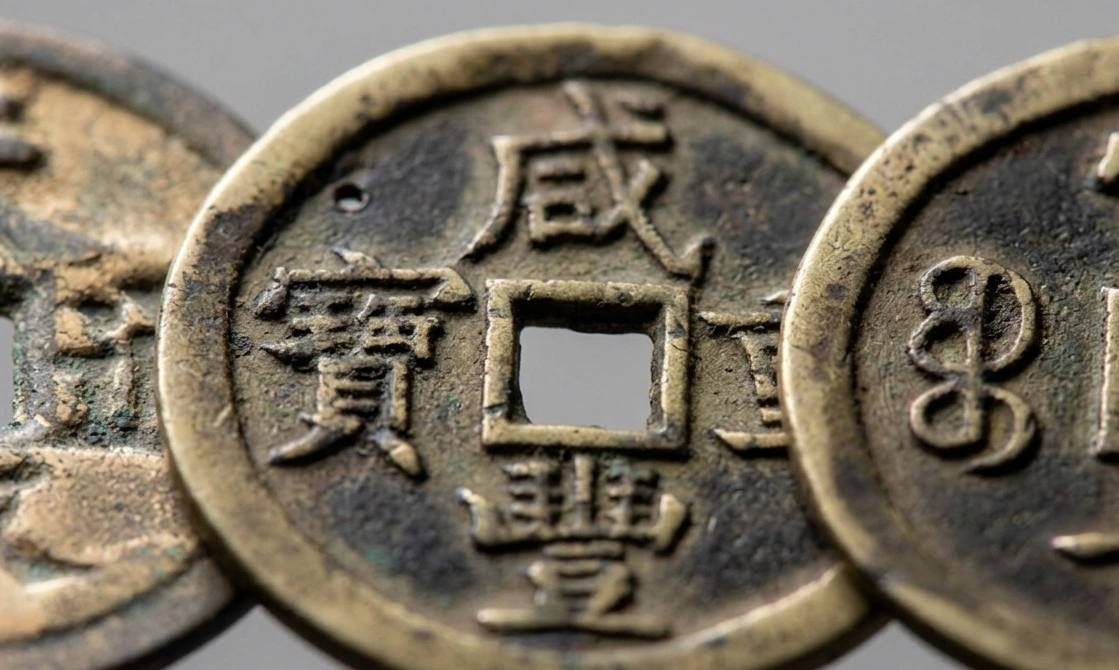
Features four characters read from top to bottom and right to left.
Text identifies the specific reign title of the emperor.
Reverse
Often remains blank in the Tang and Song dynasties.
Frequently displays mint marks in Manchu or Chinese during the Qing era.
Sometimes includes markings for denomination or weight.
Blank reverses from early eras require deep calligraphic analysis for proper identification.
Finding mint marks greatly simplifies the process of systematic cataloging.
Calligraphic Styles as a Value Driver
Designing the legends on these coins was the work of famous scholars or the emperors themselves.
Unique writing styles significantly enhance the collectible importance of a piece.
Comparing popular script styles:
Li Shu (Clerical Script)
Features wide, grounded characters with a formal appearance.
Commonly found on early Han dynasty currency.
Zhuan Shu (Seal Script)
Defined by elongated, flowing, and rounded lines.
Used for ceremonial or high-quality Song dynasty series.
Kai Shu (Regular Script)
The clear, standard font that became dominant during the Tang dynasty.
Rare variations where the same reign title is written in different scripts form "matched pairs."
Pricing for these paired sets is 30-40% higher than the combined cost of the individual coins.
Physical and Chemical Aging of Metal
Mineralization of the surface aging layer acts as irreversible proof of antiquity.
Long-term reactions in the soil create a complex structure of oxides.
Aging Layer Formation →
Metal contacts a damp environment
Primary oxide layers develop on the surface
Carbonates and sulfates begin to crystallize
Mineral crust bonds permanently to the metal
Recreating this specific structure in laboratory conditions in 2026 remains technically impossible.
Genuine aging exhibits a crystalline lattice visible only via the best free coin identifier app.
Rarity Impact on Asset Liquidity
Total surviving specimens correlate directly with the difficulty of acquisition.
Rarity Level | Known Quantity | Market Liquidity |
R1 | Millions | Low |
R5 | Several Thousands | Moderate |
R9 | Fewer than 10 units | Maximum |
Coins categorized between R7 and R10 serve as primary targets for large-scale private investments.
Market worth for these items remains independent of current economic fluctuations.
Attribution Rules for Beginning Researchers
Identifying a coin correctly requires a consistent set of actions.
Initial inspection must include measuring both the diameter and the thickness of the piece.
Cleaning the surface of loose dirt with a soft brush follows the measurement phase.
Core attribution steps:
Recognizing front-side characters using standard reference guides.
Determining the ruling period via chronological tables.
Studying back-side marks to localize the production site.
Verifying weight against historical data to exclude fakes made from lightweight alloys.
Attribution accuracy dictates the final market price of the object.
Preservation and Grading Standards
Evaluating a coin's state in 2026 relies on a specialized seventy-point scale.
Mechanical damage or signs of deep corrosion sharply reduce the final grade.
Condition criteria:
Uncirculated (MS) → No traces of wear with original mint shine present.
Extremely Fine (EF) → Minimal smoothing on the highest relief points.
Very Fine (VF) → Clear readability of all characters despite visible wear.
Fine (F) → Heavy wear where some details become unrecognizable.
Price gaps between MS and VF for rare specimens can reach up to 500%.
Storage of Numismatic Assets
Maintaining a stable environment prevents the destruction of ancient bronze.
Specific types of corrosion, often called "bronze disease," prove especially dangerous.
Protective measures:
Use individual capsules made from inert plastics.
Store in safes featuring active humidity control.
Exclude all direct sunlight from the storage area.
Avoid cleaning with aggressive industrial liquids.
Regularly inspect the coin with the coin identifier online
Damaging the surface aging layer through improper storage cuts the asset's value by 70%.
Comparison with European Currency of the Same Era
Chinese cast coins differ fundamentally from their European hammered counterparts.
Characteristic | Chinese Tradition | European Tradition |
Technology | Casting in molds | Hammering with dies |
Center Shape | Square hole | Solid disk |
Material | Bronze, Brass | Silver, Gold, Copper |
Imagery | Text only (characters) | Portraits, coats of arms, myths |
Lacking portraits made Chinese coins more universal tools for regional exchange.
Square holes allowed for the convenient transport of large sums on strings.
Interest Trends Across Various Dynasties
Market movements in 2026 show a shift in focus toward earlier historical periods.
Tang dynasty coins are considered the most liquid due to their superior casting quality.
Late Qing dynasty issues attract enthusiasts through a vast array of provincial varieties.
Auction search statistics:
Song Dynasty → 35% of inquiries
Qing Dynasty → 28% of inquiries
Tang Dynasty → 22% of inquiries
Other periods → 15% of inquiries
Song dynasty popularity stems from the massive volume of calligraphic variations available.